Chinese Household Registration Translation Guide for USCIS (2026)
If you are applying for immigration benefits in the United States and submitting Chinese documents to USCIS, you may need a certified English translation of your Chinese Household Registration document, commonly known as the Hukou (户口簿).
The Hukou is one of the most important identity and family records used in Chinese immigration documentation. USCIS often requests this document to verify family relationships, marital status, residency history, and identity information during immigration processing.
Because immigration applications are highly sensitive, even small translation errors can lead to delays, Requests for Evidence (RFEs), or application complications.
This complete 2026 guide explains everything you need to know about Chinese Household Registration translation for USCIS, including certification requirements, common translation challenges, processing times, and best practices for USCIS compliance.
What Is a Chinese Household Registration (Hukou)?
A Chinese Household Registration document, commonly called the Hukou (户口簿), is an official government-issued family registration record in China.
The Hukou system records important personal and family details for Chinese citizens and residents.
A Hukou typically includes:
- Full legal names
- Dates of birth
- Gender
- Relationship between family members
- Marital status
- Residential address
- Nationality
- Occupation
- Identification information
- Household registration status
The document serves as an official proof of identity and family structure.
USCIS frequently uses Hukou records during immigration review to confirm family relationships and personal history.
Why Does USCIS Require Translation of Hukou Documents?
USCIS requires all foreign-language documents submitted with immigration applications to include complete English translations.
According to USCIS regulation 8 CFR 103.2(b)(3):
“Any document containing foreign language submitted to USCIS shall be accompanied by a full English translation which the translator has certified as complete and accurate.”
If your Hukou document is written in Chinese, it must be translated into English before submission to USCIS.
The translation allows immigration officers to properly review and verify the information contained in the document.
When Is Hukou Translation Needed?
Chinese Household Registration translations are commonly required for various U.S. immigration applications.
Common Immigration Cases That Require Hukou Translation
These include:
- Marriage-based green card applications
- Family sponsorship petitions
- Citizenship and naturalization applications
- Adjustment of status applications
- K-1 fiancé visa applications
- Consular processing
- Immigration interviews
- Family reunification petitions
USCIS may use the Hukou to verify:
- Family relationships
- Parent-child relationships
- Marital status
- Residential history
- Household composition
- Identity consistency
What Information Must Be Translated?
A complete Hukou translation must include every visible element on the original document.
This includes:
- Main text content
- Stamps and seals
- Handwritten notes
- Government annotations
- Issue dates
- Side remarks
- Official registration markings
USCIS expects the translation to fully reflect the original document.
Incomplete translations can lead to:
- Requests for Evidence (RFEs)
- Processing delays
- Additional document requests
- Immigration complications
Professional translators usually translate all visible content, even if certain sections appear repetitive or administrative.
Common Translation Challenges in Hukou Documents
Chinese Household Registration records often contain formatting and language complexities that require experienced translation.
Here are the most common challenges.
1. Traditional vs. Simplified Chinese Characters
Most modern Hukou documents use Simplified Chinese characters.
However, older records or documents issued in certain regions may include Traditional Chinese characters.
A professional translator must accurately interpret both writing systems to avoid translation errors.
Even a single incorrect character may affect names, addresses, or family relationships.
2. Name Transliteration Issues
One of the biggest problems in Chinese immigration translation involves name consistency.
Chinese names may appear differently across documents such as:
- Passports
- Birth certificates
- Marriage certificates
- Hukou documents
- Visa records
For example:
- Zhang Wei vs. Wei Zhang
- Li Ming vs. Ming Li
Romanization differences using Pinyin or older transliteration systems can create inconsistencies.
USCIS carefully reviews names across all immigration documents.
Incorrect or inconsistent spelling can lead to confusion or delays.
Professional translators often match spellings already used in official immigration records.
3. Government and Administrative Terminology
Chinese government documents frequently contain formal administrative language that does not directly translate into English.
Examples include:
- Household registration categories
- Population registration terms
- Administrative district names
- Government office titles
These terms require accurate legal and contextual translation.
Incorrect interpretation can create misunderstandings during USCIS review.
4. Handwritten Entries and Updates
Some Hukou records contain handwritten updates or amendments.
These handwritten notes may include:
- Address changes
- Marital status updates
- Family member additions
- Administrative corrections
Handwritten Chinese characters can be difficult to read, especially in older records.
Professional review is strongly recommended for unclear handwriting.
What Makes a Hukou Translation “Certified” for USCIS?
A certified translation is required for most immigration applications submitted to USCIS.
A USCIS-certified Hukou translation should include:
- Complete English translation
- Translator certification statement
- Translator signature
- Date of certification
- Statement confirming translation accuracy
- Confirmation of language competency
USCIS generally does not require notarization for standard document translations.
However, certification is mandatory.
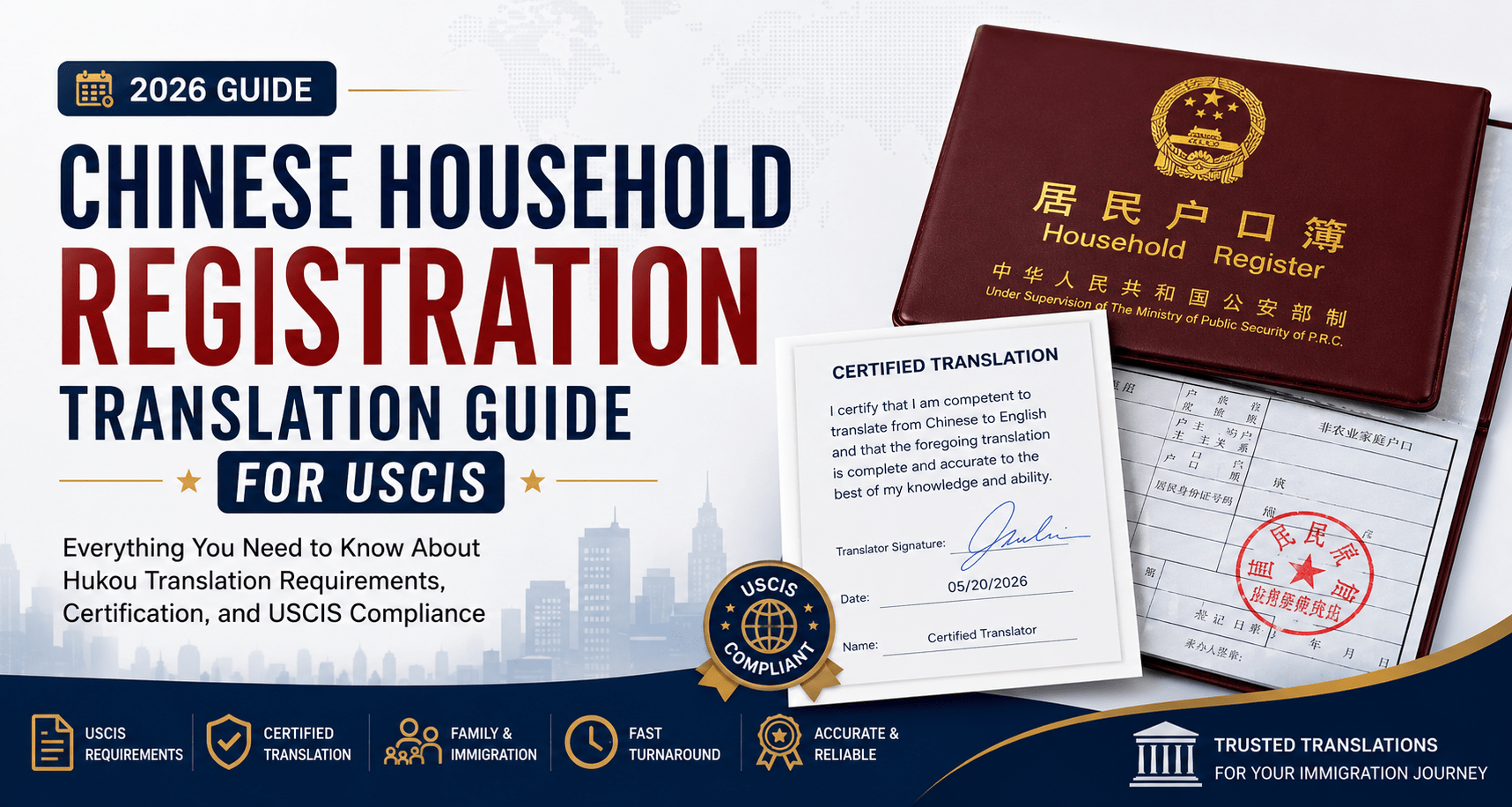
Example of a USCIS Certification Statement
A typical certification statement may read:
“I certify that I am competent to translate from Chinese to English and that the foregoing translation is complete and accurate to the best of my knowledge and ability.”
This statement confirms that the translator is qualified and that the translation accurately reflects the original Chinese document.
Can You Translate Your Own Hukou Document?
USCIS generally discourages applicants from translating their own immigration documents.
Although not always explicitly prohibited, self-translation may create concerns about impartiality and accuracy.
Family members are also usually not recommended as translators for immigration paperwork.
Using a professional translation service helps reduce the risk of:
- RFEs
- Delays
- Translation disputes
- Application complications
Professional translators familiar with immigration terminology can ensure compliance with USCIS standards.
Are Machine Translations Acceptable?
Automated tools like Google Translate should not be used alone for official immigration translations.
Machine translations often fail to properly interpret:
- Legal terminology
- Government wording
- Handwritten notes
- Administrative phrases
- Cultural naming conventions
Errors in immigration translations can create serious complications.
USCIS generally expects professionally reviewed human translations.
How Long Does Hukou Translation Take?
Most standard Hukou translations are completed quickly by professional translation providers.
Typical Turnaround Times
- Standard documents: 12–48 hours
- Multi-page records: 2–5 business days
- Handwritten or complex records: Longer processing times
Delivery speed depends on:
- Document clarity
- Number of pages
- Handwriting complexity
- Formatting requirements
- Certification needs
Some providers also offer expedited same-day service.
Tips Before Uploading Your Hukou for Translation
Preparing your document correctly helps avoid delays and improves translation accuracy.
Best Practices Before Submission
- Scan all pages clearly
- Include cover pages
- Avoid cropped edges
- Ensure stamps and seals are visible
- Upload high-resolution copies
- Include handwritten pages
- Do not edit the original document
Poor-quality scans are one of the most common causes of translation delays.
Common Mistakes to Avoid
Many immigration applicants accidentally submit incomplete or inaccurate translations.
Avoid these common errors:
- Missing pages
- Incomplete translations
- Incorrect spelling of names
- Ignoring handwritten notes
- Cropped seals or stamps
- Using machine-only translation tools
- Inconsistent dates or family details
Even minor inconsistencies can trigger additional scrutiny from USCIS.
Are Digital Copies Accepted by USCIS?
In many immigration cases, USCIS accepts scanned digital copies submitted online or by mail.
However, the translation must still:
- Be complete
- Include certification
- Match the original document accurately
- Clearly display all content
Always review the latest USCIS filing instructions for your specific immigration form.
Requirements may vary depending on the application type.
Why Professional Hukou Translation Matters
A Chinese Household Registration document contains sensitive identity and family information.
Accurate translation is essential because USCIS relies on this document to verify:
- Family relationships
- Marital status
- Residential records
- Immigration eligibility
- Identity consistency
Small mistakes involving names, dates, or family relationships can result in delays or Requests for Evidence.
Professional human translators familiar with Chinese immigration documents help ensure:
- USCIS compliance
- Translation accuracy
- Consistent terminology
- Proper formatting
- Reduced immigration risks
Final Thoughts
Chinese Household Registration (Hukou) translation plays a critical role in many U.S. immigration applications.
USCIS requires all Chinese-language documents to include complete and certified English translations.
To avoid delays and complications, your Hukou translation should:
- Be complete
- Include all stamps and notes
- Maintain name consistency
- Be professionally certified
- Follow USCIS requirements carefully
Because Hukou documents contain detailed family and residency information, accuracy is extremely important.
Using a professional human translator experienced in USCIS immigration documentation can help ensure your Chinese Household Registration translation is accepted quickly and without unnecessary issues.