Introduction
If you are preparing immigration documents for USCIS, you have likely come across two confusing terms: certified translation and notarized translation. Many applicants use these words interchangeably, but they are completely different, and mixing them up can cause costly delays in your immigration case.
This 2026 guide will explain exactly what USCIS requires, the difference between the two, and how to make sure your documents are accepted the very first time.
What Is a Certified Translation?
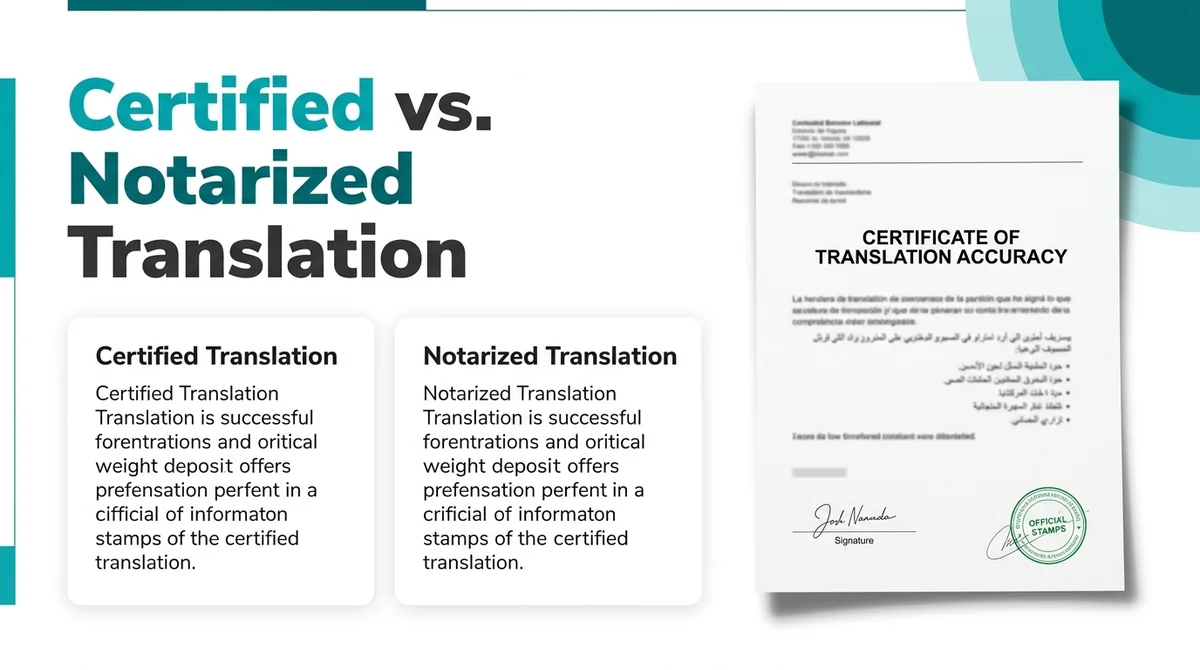
A certified translation is a translated document accompanied by a signed statement from the translator or translation company. This statement — called a Certificate of Translation Accuracy — declares that:
- The translation is complete and accurate to the best of the translator’s knowledge
- The translator is fluent in both the source language and English
- The translator’s name, contact information, and signature are included
USCIS requires certified translations for ALL foreign-language documents submitted with immigration applications. This is governed by 8 CFR 103.2(b)(3).
What Is a Notarized Translation?
A notarized translation goes one step further. In addition to the certified translation, a Notary Public witnesses the translator’s signature and verifies the identity of the person signing. Important: the notary does NOT verify the accuracy of the translation — they only verify the signature.
Notarized translations are sometimes required by courts, state departments, universities, or foreign embassies — but NOT by USCIS.
USCIS Official Rule (8 CFR 103.2)
• USCIS requires certified translations — NOT notarized translations
• The translator must be competent in both languages
• No government-approved translator list exists — any competent professional qualifies
• Missing certification is a top cause of RFE (Request for Evidence)
Which One Do You Need?
The answer is simple: for USCIS, you only need a certified translation. If a court or state board also requests the same document, you may additionally need a notarized version. A professional service like uscis-translations.com can prepare both from a single order, saving you time and money.
Common Mistakes to Avoid
- Paying extra for notarization when USCIS doesn’t require it
- Using a family member or friend to translate — this may raise bias concerns
- Missing the translator’s signature or contact information on the certificate
- Submitting only part of the document instead of a full word-for-word translation
Need USCIS-Approved Certified Translation?
Fast, accurate & USCIS accepted
- 24-Hour Turnaround
- 100% Acceptance Rate
- Notary Available