The Cost of Getting It Wrong
Every year, thousands of immigration applications are delayed — or rejected outright — because of preventable translation errors. A missing certification statement, an inconsistent document format, or an inaccurate rendering of a name or date can trigger a Request for Evidence (RFE), restart processing timelines, and add months to an already demanding process.
Understanding exactly what USCIS requires from translated documents is not optional. It is one of the most important steps you can take to protect your application.
What USCIS Requires: The Official Standard
The United States Citizenship and Immigration Services (USCIS) mandates that every document submitted in a language other than English must be accompanied by a full and complete English translation. This requirement applies to all foreign-language documents in your application package — birth certificates, marriage records, court documents, diplomas, financial records, and more.
USCIS is explicit about what a compliant translation must include. Here is what every submission must meet:
1. Translator Competency
USCIS does not require translators to hold a specific credential or certification from a particular body. However, the translator must be competent in both the source language and English. More critically, they must be able to certify — in writing — that they are competent to translate and that the translation is accurate and complete.
This means:
- The translator cannot be the applicant themselves
- The translator must have genuine proficiency in both languages
- Competency must be attested in a signed certification statement
While USCIS does not mandate a specific professional credential, working with a professional translator or accredited translation agency significantly reduces the risk of errors that could compromise your case.
2. A Signed Certificate of Translation Accuracy
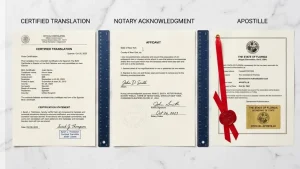
This is one of the most frequently overlooked requirements — and one of the most consequential. Every translated document submitted to USCIS must be accompanied by a signed Certificate of Translation Accuracy.
This certificate must include:
- A statement that the translator is competent in both the source and target languages
- A statement that the translation is true and accurate to the best of the translator’s knowledge
- The translator’s full name, signature, date, and contact information
Without this certification, your document does not meet USCIS standards — regardless of how accurate the translation itself may be. A missing or incomplete certificate is a common reason for RFEs and processing delays.
3. Complete and Accurate Translation — No Omissions
USCIS requires that translations be complete. Every element of the original document must be reflected in the translation — names, dates, places, official seals, stamps, annotations, and even notations about illegible or damaged sections.
Selective or partial translations are not acceptable. If a section of the original document is unclear or illegible, this must be noted explicitly in the translation itself. Omitting content — even content that appears minor — can raise questions about the integrity of the submission.
4. Format Consistency
The translated document should mirror the layout and structure of the original as closely as possible. This means:
- Preserving the relative position of fields, entries, and sections
- Reproducing headers, footers, official titles, and document identifiers
- Maintaining the visual organization of tables, columns, or formatted sections
Format consistency matters because USCIS officers review translated documents alongside the originals. A translation that is difficult to cross-reference increases the chance of errors being flagged during review.
Common Translation Mistakes That Trigger RFEs
Even well-intentioned applicants run into problems when translation requirements are not fully understood. These are the most common errors that lead to delays:
| Mistake | Consequence |
|---|---|
| Missing Certificate of Accuracy | Automatic non-compliance; likely RFE |
| Partial translation of document | Application flagged for incompleteness |
| Inconsistent name spelling across documents | Identity verification concerns |
| Incorrect date formatting | Processing errors or document mismatch |
| Untranslated stamps, seals, or annotations | Incomplete record; potential rejection |
| Using machine translation without certification | Not compliant with USCIS standards |
Why Professional Translation Services Matter for USCIS Submissions
USCIS translation is not a general language task — it is a compliance exercise with real legal stakes. Professional translation services bring three things that machine tools and unqualified translators cannot:
1. Immigration-Specific Expertise Professional translators working in the immigration space understand USCIS document types, the terminology used in civil records across different countries, and the formatting expectations of federal reviewers. This expertise reduces errors before they become problems.
2. Certified Documentation Reputable translation services provide a properly formatted Certificate of Translation Accuracy with every document — signed, dated, and compliant with USCIS standards. This is included as a standard part of the service, not an add-on.
3. Accountability and Quality Review Professional services apply multi-step review processes to every translation before delivery. This means errors are caught internally — not by a USCIS officer reviewing your application.
Which Documents Typically Require Translation for USCIS?
If you are submitting an immigration application, you will likely need certified English translations of some or all of the following:
- Birth certificates
- Marriage and divorce certificates
- Adoption records
- Death certificates
- Court records and criminal history documents
- Academic diplomas and transcripts
- Military records
- Financial documents (foreign bank statements, tax records)
- National identity documents or passports
- Medical records (for certain visa categories)
If a document is in a language other than English and it is part of your application package, it requires a compliant translation — no exceptions.
Conclusion: Compliance Is the Foundation of a Strong Application
USCIS translation requirements exist to ensure the integrity of the immigration process. Meeting them precisely — with complete translations, properly formatted documents, and certified accuracy statements — is one of the most direct ways to strengthen your application and avoid costly delays.
The requirements are clear. The risk of non-compliance is real. And the solution is straightforward: work with professional translators who specialize in USCIS document translation and understand what federal reviewers expect.
[Get a Free Quote for USCIS-Certified Translation →]
USCIS-Translations.com specializes in certified English translations for immigration applications. Every translation includes a compliant Certificate of Accuracy and meets current USCIS formatting and documentation standards. Contact us today to get started.