French Document Translation for USCIS – Complete Guide (2026)
If you are submitting French-language documents to the United States Citizenship and Immigration Services (USCIS), you will usually need a certified English translation. USCIS requires all foreign-language documents submitted with immigration applications to include a complete English translation along with a certification confirming the translation is accurate and complete.
French is one of the most commonly submitted foreign languages in U.S. immigration cases because applicants often provide documents issued in countries such as France, Canada, Belgium, Switzerland, Haiti, Senegal, Morocco, Algeria, and other French-speaking regions.
Even small translation mistakes can lead to Requests for Evidence (RFEs), processing delays, or additional scrutiny from USCIS officers.
This complete 2026 guide explains everything you need to know about French document translation for USCIS, including certification requirements, common document types, translation mistakes to avoid, turnaround times, and best practices for compliance.
Does USCIS Accept French Documents Without Translation?
No. USCIS generally requires all foreign-language documents, including French documents, to be translated into English before submission.
According to USCIS regulation 8 CFR 103.2(b)(3):
“Any foreign language document submitted to USCIS must include a full English translation and a certification from the translator confirming that the translation is complete and accurate.”
If your documents contain French text, you must provide a certified English translation with your immigration application.
Failure to include proper translation may result in:
- Application delays
- Requests for Evidence (RFEs)
- Rejection of supporting documents
- Additional immigration review
Common French Documents That Require Translation
Applicants commonly submit French-language documents from countries including:
- France
- Canada (Quebec)
- Belgium
- Switzerland
- Haiti
- Cameroon
- Senegal
- Morocco
- Algeria
- Ivory Coast
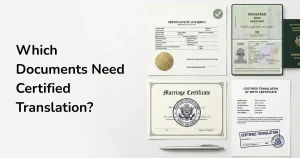
USCIS may require certified translations for many different document types.
Civil Documents
Civil records are among the most frequently translated French documents for immigration purposes.
These include:
- Birth certificates
- Marriage certificates
- Divorce decrees
- Death certificates
- Adoption records
- Family registration documents
These records are often required for green card applications, family petitions, and citizenship cases.
Immigration and Identity Documents
Identity verification documents frequently require certified French-to-English translation.
Examples include:
- Passports
- National ID cards
- Residency permits
- Immigration records
- Police clearance certificates
- Travel documents
USCIS uses these records to verify identity, immigration history, and eligibility.
Academic Documents
Students and employment-based applicants may need translations of educational records.
Common academic documents include:
- Diplomas
- University transcripts
- School records
- Degree certificates
- Enrollment letters
Universities and employers may also require credential evaluations in addition to certified translations.
Financial and Legal Documents
Legal and financial records often require professional translation for immigration review.
These may include:
- Bank statements
- Court records
- Tax documents
- Employment verification letters
- Contracts
- Business registration documents
Accurate legal terminology is especially important for these document types.
What Makes a Translation “Certified” for USCIS?
A USCIS-certified translation is more than a simple translation.
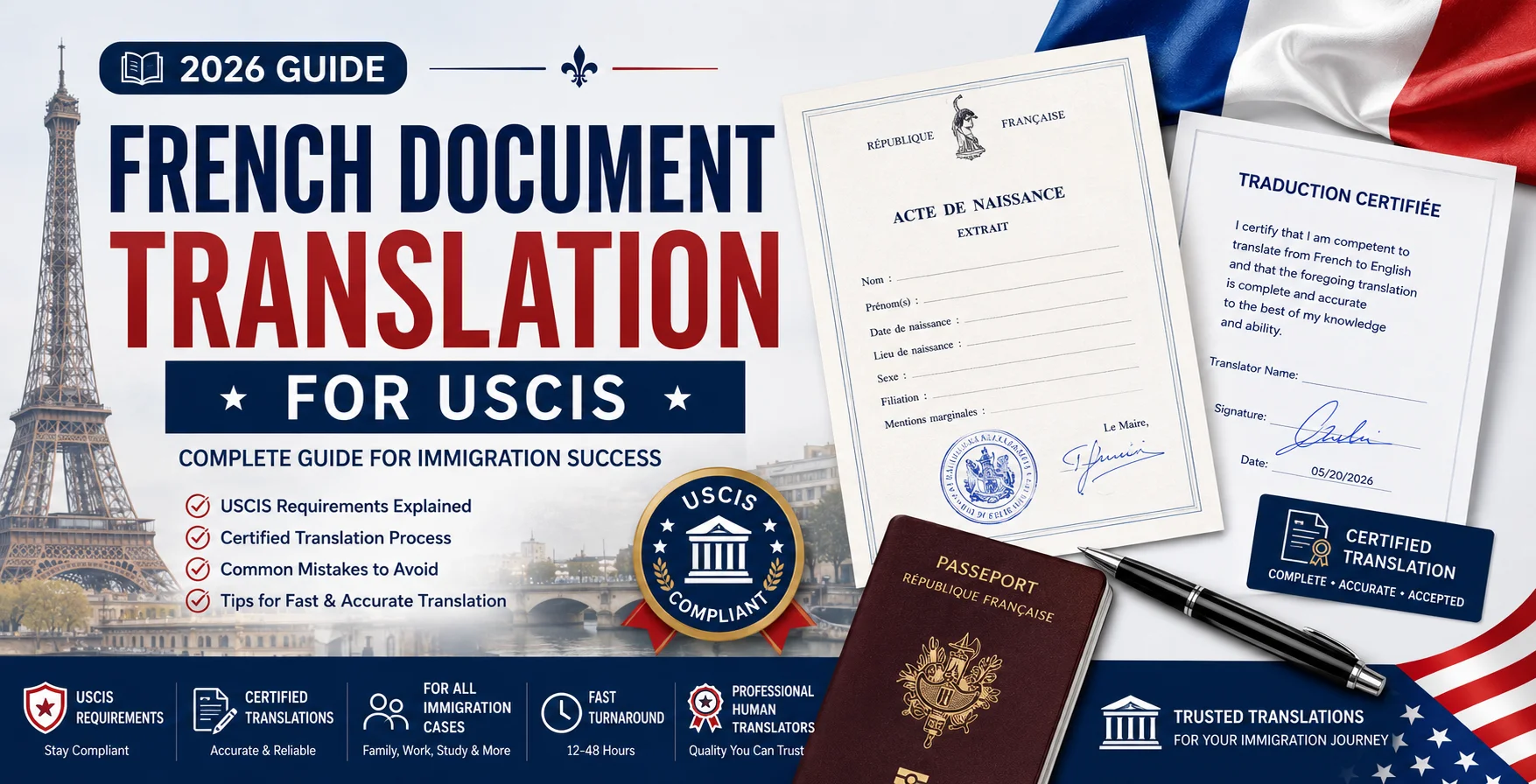
It must include:
- Complete English translation
- Accurate translation of all text
- Translation of stamps and seals
- Translator certification statement
- Translator’s name and signature
- Date of certification
The translator must certify that the translation is complete and accurate.
USCIS does not officially certify translators themselves. Instead, the translator provides a signed certification statement.
Example of a USCIS Certification Statement
A standard certification statement may read:
“I certify that I am competent to translate from French to English and that the foregoing translation is complete and accurate to the best of my knowledge and ability.”
This statement confirms the translator’s language competency and translation accuracy.
Common Mistakes in French USCIS Translations
Translation mistakes are one of the most common causes of immigration delays.
Here are some of the most frequent problems.
1. Incomplete Translation
USCIS requires complete translations of all visible text.
Applicants sometimes forget to translate:
- Stamps
- Seals
- Marginal notes
- Handwritten comments
- Administrative annotations
Incomplete translations can lead to Requests for Evidence (RFEs).
Professional translators ensure every visible element is translated properly.
2. Incorrect Name Transliteration
French names often contain accents and special characters such as:
- É
- Ç
- À
- È
- Ô
Examples include:
- José
- François
- Chloë
- André
Names should match passports and immigration records exactly whenever possible.
Inconsistent spelling can create confusion during USCIS review.
3. Machine Translation Errors
Automatic translation tools such as Google Translate are not reliable for immigration documentation.
Machine translations may incorrectly translate:
- Legal terminology
- Civil status language
- Government wording
- Regional French expressions
For example, terms related to marital status or legal judgments may be translated inaccurately.
USCIS generally expects professional human-reviewed translations.
4. Poor Formatting and Layout
A translated document should closely mirror the structure of the original document.
This helps USCIS officers compare the original French document with the English translation quickly and efficiently.
Poor formatting may create confusion or slow review.
Professional translators usually preserve:
- Table structure
- Line order
- Section headings
- Stamp placement
- Formatting hierarchy
Do French Canadian Documents Need Translation?
Yes. French-language Canadian documents must also be translated for USCIS if they contain French text.
This commonly applies to documents issued in Quebec and other French-speaking regions of Canada.
Examples include:
- Quebec birth certificates
- French-language marriage certificates
- Canadian school transcripts in French
- Provincial legal records
Even though the document originates from Canada, USCIS still requires English translation if the content is in French.
Can You Translate Your Own French Documents?
USCIS generally discourages applicants from translating their own immigration documents.
Although self-translation is not always explicitly prohibited, it may create credibility concerns.
Family members are also typically not recommended as translators for immigration submissions.
Using an independent professional translator helps reduce the risk of:
- RFEs
- Delays
- Translation disputes
- Inconsistencies
Professional translators familiar with immigration terminology can help ensure compliance with USCIS standards.
How Long Does French Translation Take?
Most standard USCIS French document translations are completed quickly.
Typical Turnaround Times
- Simple documents: 12–48 hours
- Multi-page legal records: 2–5 business days
- Handwritten or complex documents: Longer processing times
Turnaround time depends on:
- Document complexity
- Number of pages
- Handwriting quality
- Formatting requirements
- Certification needs
Some providers also offer expedited same-day translation services.
Tips Before Uploading Your French Documents
Proper preparation helps improve translation accuracy and reduce delays.
Best Practices Before Submission
- Scan all documents clearly
- Include every page
- Avoid cropped edges
- Ensure stamps and seals are visible
- Upload high-resolution files
- Include handwritten sections
- Avoid editing the original document
Poor-quality scans are one of the most common reasons for translation delays.
Are Digital Copies Accepted by USCIS?
In many immigration cases, USCIS accepts scanned copies submitted online or by mail.
However, the translation must still:
- Be complete
- Include certification
- Match the original document accurately
- Clearly display all translated content
Always review the latest USCIS filing instructions for your specific immigration form.
Requirements may vary depending on the application type.
Why Professional French Translation Matters
Immigration documents contain highly sensitive legal and personal information.
Professional French translation helps ensure:
- Accurate legal terminology
- Proper name consistency
- USCIS compliance
- Clear formatting
- Reduced risk of RFEs
Even small mistakes involving names, dates, or legal terminology can affect immigration processing.
Experienced human translators familiar with USCIS documentation can help ensure your application materials are accepted smoothly.
Final Thoughts
French document translation for USCIS requires accuracy, completeness, and proper certification.
Whether you are translating:
- A French birth certificate
- Marriage certificate
- Academic transcript
- Legal document
- Police certificate
- Immigration record
Your translation should always be:
- Complete
- Properly certified
- Clearly formatted
- Carefully reviewed
Because immigration applications are highly detail-sensitive, professional human translation is strongly recommended.
Using a qualified translator experienced in USCIS immigration requirements can help reduce delays, avoid Requests for Evidence, and ensure your French-language documents meet official USCIS standards.