Why Your Birth Certificate Translation Can Make or Break Your Application
Your birth certificate is one of the most foundational documents in any U.S. immigration application. It establishes your identity, nationality, and family relationships — facts that USCIS must be able to verify with absolute clarity. If your birth certificate is in a language other than English, the translation you submit carries the same weight as the document itself.
A flawed translation — incomplete, uncertified, or inaccurately formatted — can trigger a Request for Evidence (RFE), stall your application for months, or in serious cases, lead to outright rejection. The good news: these outcomes are entirely preventable when you understand exactly what USCIS requires.
USCIS Translation Requirements for Birth Certificates: A Full Breakdown
1. Every Word Must Be Translated — No Exceptions
USCIS requires that birth certificate translations be complete. This means every element of the original document must appear in the English translation, including:
- Full names (as written, without alteration)
- Dates and places of birth
- Parents’ names and details
- Registrar information and official titles
- Stamps, seals, and their text
- Marginal notes or handwritten annotations
- Any corrections or endorsements on the original
Partial translations are not acceptable. If any section is left untranslated — even a stamp or a footer — your submission is non-compliant.
2. A Signed Certificate of Translation Accuracy Is Mandatory
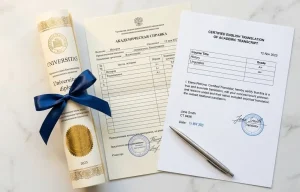
This is the requirement most commonly missed, and the one most likely to trigger an RFE. Every translated birth certificate submitted to USCIS must be accompanied by a signed Certificate of Translation Accuracy.
This certificate must state:
- That the translator is competent in both the source language and English
- That the translation is accurate and complete to the best of the translator’s knowledge
- The translator’s full name, signature, date, and contact information
Without this certification, the translation does not meet USCIS standards — regardless of its accuracy. Note that notarization is not required by USCIS for most applications; the translator’s signed certification is sufficient. However, certain state agencies or specific visa categories may have additional requirements, so always verify before submitting.
3. Translator Competency
USCIS does not mandate a specific credential or membership in a professional body. However, the translator must be genuinely competent in both languages and must be able to certify as much in writing. Critically, the applicant cannot translate their own documents.
Working with a professional translation service that specializes in immigration documents is strongly recommended. The stakes of an error are high, and professionals in this space understand both the linguistic demands and the formatting standards USCIS reviewers expect.
4. Format Must Mirror the Original
The translated document should replicate the structure and layout of the original birth certificate as closely as possible. USCIS officers often review translated documents side by side with the originals. A translation that is difficult to cross-reference — because fields are reorganized or layout is inconsistent — increases the chance of discrepancies being flagged.
This includes preserving the relative positioning of fields, maintaining document headers and footers, and clearly labeling any sections that are illegible or damaged in the original.
5. Legibility and Typed Text
All translated content must be clearly legible. Any handwritten sections in the original document must be fully typed out in the English translation. Submitting a handwritten translation is not recommended and may be rejected on legibility grounds alone.
Common Mistakes That Delay USCIS Applications
| Mistake | Why It Causes Problems |
|---|---|
| Missing Certificate of Accuracy | Translation is non-compliant without it |
| Partial translation (missing stamps or seals) | Application flagged as incomplete |
| Name spelled differently than on other documents | Triggers identity verification concerns |
| Using Google Translate or other machine tools | Does not meet USCIS certification requirements |
| Handwritten translations | Legibility standards not met |
| Incorrect date format | Can create document mismatch during review |
| Applicant translating their own document | Not permitted under USCIS guidelines |
Step-by-Step: How to Get Your Birth Certificate Translated for USCIS
Step 1 — Obtain a clear copy of your birth certificate Provide the translator with the clearest possible copy of the original document. Poor image quality leads to inaccuracies, and any unclear sections must be explicitly noted in the translation.
Step 2 — Choose a professional translation service with immigration experience Look for translators or agencies that specialize in USCIS document translation. They will understand not just the language, but the formatting requirements and certification standards that federal reviewers expect.
Step 3 — Review the completed translation carefully Before submitting, compare the English translation against the original document line by line. Verify that all names, dates, places, and official notations are accurately reflected and consistently spelled across your full application package.
Step 4 — Confirm the Certificate of Accuracy is included Ensure the translation is accompanied by a signed, dated certification statement from the translator. This document is not optional — it is what makes the translation officially compliant with USCIS requirements.
Step 5 — Submit both the original and the translation together Always include the original foreign-language document alongside the certified English translation. USCIS requires both.
Frequently Asked Questions
Does USCIS require a notarized translation of a birth certificate? For most USCIS applications, notarization is not required. A signed Certificate of Translation Accuracy from a competent translator is sufficient. Some state-level agencies or specific visa types may have additional requirements — verify on a case-by-case basis.
Can I use Google Translate for my birth certificate? No. Machine translation tools do not provide the signed certification required by USCIS and cannot guarantee accuracy for legal documents. Using automated tools for official submissions puts your application at risk.
Can I translate my own birth certificate for USCIS? No. USCIS does not permit applicants to translate their own documents. The translator must be a separate, competent individual who can certify the accuracy of the translation independently.
What languages do birth certificates most commonly need to be translated from? Spanish, Chinese (Simplified and Traditional), Hindi, Tagalog, Vietnamese, Korean, Arabic, and Portuguese are among the most frequently translated languages for USCIS submissions — but the requirement applies to any language other than English.
Conclusion: Accuracy and Compliance, Not Just Translation
Your birth certificate translation is a legal document in the eyes of USCIS. It needs to be complete, accurately formatted, and certified — every time, without exception. The margin for error is narrow, and the cost of a mistake is measured in months of processing delays or a rejected application.
Professional translation services that specialize in USCIS submissions eliminate that risk. They understand what compliance looks like from the inside, and they deliver translations that hold up to federal scrutiny.
[Get Your Birth Certificate Translated — Free Quote →]
USCIS-Translations.com provides certified English translations of birth certificates and all immigration documents. Every translation includes a compliant Certificate of Accuracy and meets current USCIS standards. Visit this page to get started today.