
Certified Marriage Certificate Translation for USCIS | $18/page | 100% Accepted
Fast. Accurate. 100% USCIS Accepted. Starting at $18/Page — Delivered in 24 Hours.
Need a certified marriage certificate translation for USCIS? USCIS Translations provides fast, accurate, and fully compliant certified translations accepted by U.S. Citizenship and Immigration Services (USCIS), immigration attorneys, U.S. consulates, federal courts, and government agencies across the United States. Starting at $18 per page. Delivered within 24 hours. Every order includes a signed Certificate of Translation Accuracy. Our ATA-certified professionals have completed more than 15,000 certified immigration document translations across 65+ languages.
⚠️ Important: Missing or inaccurate marriage certificate translations can result in a Request for Evidence (RFE), interview delays, or outright rejection of your immigration application. Every certified translation we deliver is guaranteed to be accepted by USCIS.
100% USCIS acceptance guaranteed


Need it faster? Expedited 12–24hr delivery available at $28/page

What Is a Certified Marriage Certificate Translation?
A certified marriage certificate translation is a complete, word-for-word English version of your foreign-language marriage certificate, accompanied by a signed Certificate of Translation Accuracy. This signed statement formally confirms:
- The translation is complete and accurate with no omissions.
- The translator is fully competent to translate from the source language into English.
- The translated document faithfully reflects all text, stamps, seals, and annotations from the original.
✅ Note: USCIS does not require marriage certificate translations to be notarized. A signed certification statement is all that is required for standard immigration filings, including Form I-485, Form I-130, and Form N-400. Notarization is only required when specifically requested by a court, university, or foreign government agency.
USCIS Marriage Certificate Translation Requirements
Under 8 CFR 103.2(b)(3), USCIS requires that any foreign-language document submitted with an immigration petition be accompanied by a complete English translation. For a marriage certificate translation to be USCIS-compliant, it must:
- Be translated entirely into English
- Include all visible text — printed fields, handwritten entries, stamps, seals, signatures, marginal annotations, and registration numbers
- Be complete with no omissions or paraphrasing
- Include a signed Certificate of Translation Accuracy from the translator or translation company
- Be submitted alongside a copy of the original foreign-language document
⚠️ Important: Missing or inaccurate translations can result in processing delays, Requests for Evidence (RFEs), or outright application rejections by USCIS.
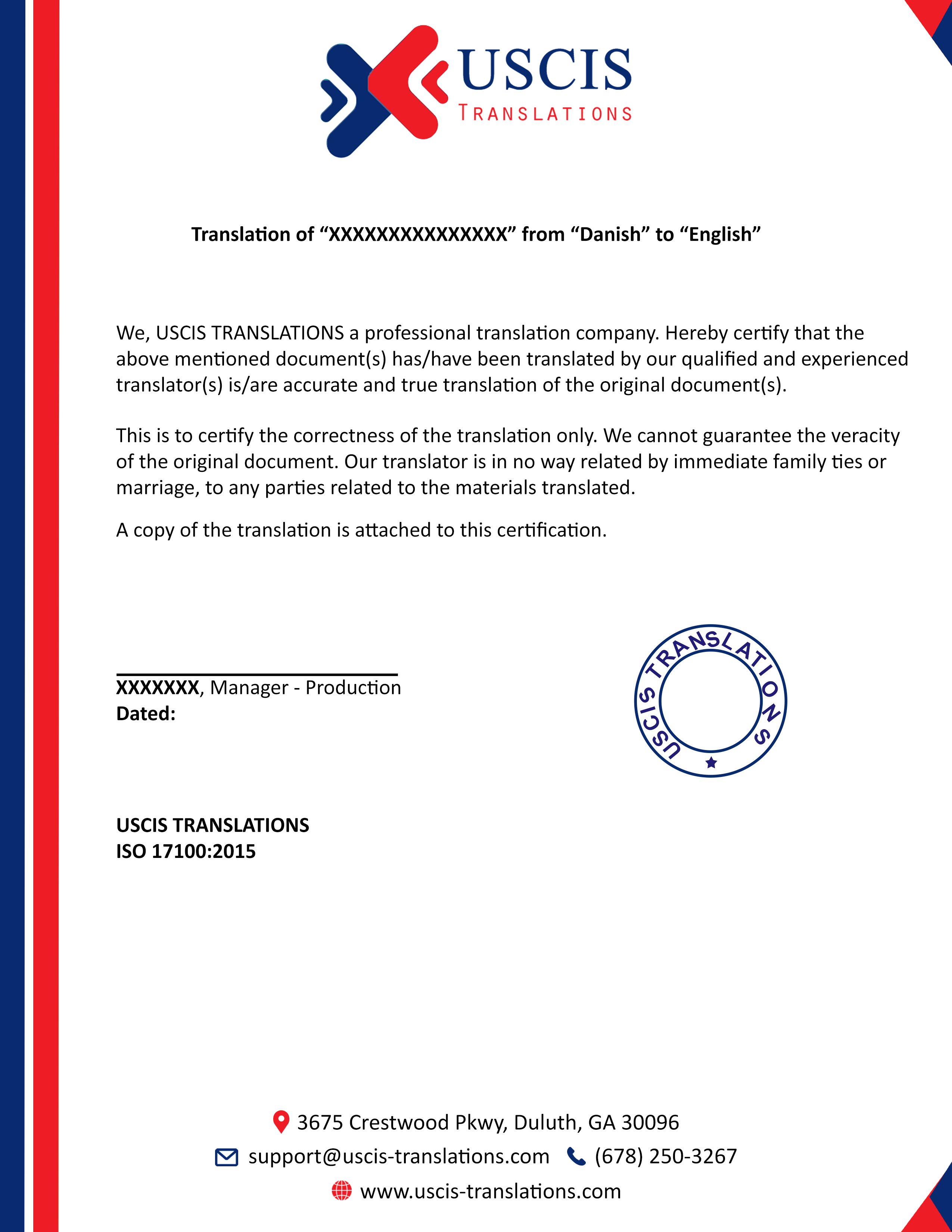
Sample certified translations
Our translations follow the same format as your source document, however we do not attempt to replicate its appearance. All translations are produced on our USCIS translations stationery and include a signed and sealed Certificate of Translation Accuracy.

$18/ page
- Expedited Delivery at $28/ page
- Certificate of accuracy
- 12-24 hours delivery available
- Native professional translators
Optional Add-ons
Notarization available at $9
Physical Delivery at $12
Others
$25- $30/Page
- Expedited Delivery at $35- $45/ page
- Certificate of accuracy
- 24-48 hour delivery
- Professional translators
How to Get Your Certified Marriage Certificate Translation

Step 1: Upload
Provide a clear scan, high-resolution photo, or PDF of your marriage certificate through our secure online portal. No mailing required — the original document stays with you.

Step 2: Select Language & Quote
Choose your language pair and preferred turnaround time. Receive a flat-rate quote instantly — starting at $18/page with no hidden fees. Same-day expedited service (12 hours or less) is available for urgent immigration deadlines.

Step 3: Translation, Review & Delivery
A native-speaking professional translator translates your document — including all stamps, seals, signatures, and annotations. A second linguist reviews for accuracy and USCIS formatting compliance. Your completed certified translation, including the signed Certificate of Translation Accuracy, is delivered directly to your inbox as a high-quality PDF — ready to submit to USCIS.
Certified vs. Notarized Translation: What Does USCIS Require?
This is one of the most common points of confusion for immigration applicants. Here is the exact difference:
| Certified Translation | Notarized Translation | |
|---|---|---|
| What it includes | Signed Certificate of Translation Accuracy from the translator | Notary public acknowledgment verifying the signer's identity |
| Does it verify accuracy? | ✅ Yes — translator certifies completeness and accuracy | ❌ No — notary only verifies the identity of the person who signed |
| Required by USCIS? | ✅ Yes — required for I-485, I-130, N-400, and all standard filings | ❌ Not required by USCIS for standard immigration filings |
| When is it needed? | All USCIS immigration filings with foreign-language documents | Courts, universities, or foreign governments that specifically request it |
Supported Languages & Regional Specializations
We provide certified marriage certificate translations in more than 65 languages. Our translators specialize in regional dialects, handwritten notations, civil registry formats, and localized administrative terminology.
🇲🇽 Spanish Marriage Certificate Translation
We regularly translate civil documents from Mexico, Spain, Colombia, Argentina, Peru, Chile, the Dominican Republic, Ecuador, Guatemala, Honduras, Venezuela, and Cuba. Mexican Actas de Matrimonio from municipal civil registry offices contain civil registry numbers, witness information, and official government seals — our translators capture every registration detail required for green card and spouse visa applications.
🇮🇳 Indian Marriage Certificate Translation
We translate documents issued under the Hindu Marriage Act, the Special Marriage Act, and municipal corporation registrations in: Hindi, Marathi, Gujarati, Punjabi, Tamil, Telugu, Malayalam, Kannada, Bengali, Urdu, Odia, and other regional languages. Our translators handle both typed and handwritten Indian civil documents, including older archival certificates.
🇵🇭 Filipino (Tagalog) Marriage Certificate Translation
Philippine Statistics Authority (PSA)-issued marriage certificates are among the most commonly filed civil documents in USCIS spousal and K-1 visa applications. Our translators specialize in PSA certificate formats, including documents referencing local civil registry numbers, church marriage records, and annotations.
🇨🇳 Chinese Marriage Certificate Translation
We provide expert certified translations of Chinese marriage certificates issued by the Ministry of Civil Affairs (民政局). Our translators accurately render Chinese name characters (simplified and traditional), registration numbers, official red star stamps, and the formatted date system used in mainland Chinese civil documents.
🇸🇦 Arabic Marriage Certificate Translation
Arabic marriage certificates — including Islamic (religious) marriage contracts and civil registry documents from Egypt, Jordan, Lebanon, Morocco, Saudi Arabia, the UAE, Iraq, and other Arabic-speaking countries — require expertise in legal phrasing, religious terminology, and complex handwritten cursive scripts.
🇷🇺 Russian & Ukrainian Marriage Certificate Translation
We specialize in certified translations from Russia, Ukraine, Belarus, Kazakhstan, and other post-Soviet states. Our expert translators ensure Cyrillic script names, regional patronymics, government stamps (gerbovaya pechat), and official apostille notations are accurately translated and fully USCIS-compliant.
Other Supported Languages
We also regularly translate marriage certificates from: Portuguese (Brazil, Portugal, Cape Verde) · French (France, Cameroon, Senegal, Haiti, Morocco) · Korean · Japanese · German · Italian · Turkish · Urdu (Pakistan) · Persian/Farsi (Iran — including Solar Hijri/Jalali calendar) · Amharic (Ethiopia — including Ethiopian calendar) · Hebrew (Israel)
Supported Languages & Regional Specializations
- Spanish (Mexico, Colombia, Dominican Republic, etc.): We translate Actas de Matrimonio including civil registry numbers, witness info, and official government seals from all Latin American civil registry offices.
- Indian Marriage Certificates: Documents issued under the Hindu Marriage Act, Special Marriage Act, and municipal corporation registrations in Hindi, Marathi, Gujarati, Punjabi, Tamil, Telugu, Malayalam, Kannada, Bengali, Urdu, Odia, and other regional languages.
- Filipino (Tagalog): Philippine Statistics Authority (PSA)-issued marriage certificates including local civil registry numbers, church marriage records, and annotations.
- Chinese: Documents from the Ministry of Civil Affairs (民政局), accurately rendering Chinese name characters, registration numbers, official red star stamps, and formatted dates.
- Arabic: Islamic marriage contracts and civil registry documents from Egypt, Jordan, Lebanon, Morocco, Saudi Arabia, UAE, Iraq, and other Arabic-speaking countries.
- Russian & Ukrainian: Cyrillic script names, regional patronymics, government stamps (gerbovaya pechat), and official apostille notations — fully USCIS compliant.
- Other Languages: Portuguese, French, Korean, Japanese, German, Italian, Turkish, Urdu, Persian/Farsi (Solar Hijri calendar), Amharic (Ethiopian calendar), Hebrew, and 50+ more.
Why Thousands Trust USCIS Translations
ATA Corporate Member
Official member of the American Translators Association — Corporate Member #280493. Our credentials appear on every signed Certificate of Translation Accuracy.
100% USCIS Compliance
Every translation is formatted to meet strict 8 CFR 103.2(b)(3) requirements. We guarantee acceptance by USCIS, immigration courts, and U.S. consulates.
Professional 2-Stage Review
Every translation undergoes a second independent review by a senior linguist before delivery. Stamps, seals, handwritten annotations — nothing is missed.
Spanish to English
“I needed a certified translation of my Mexican marriage certificate for my I-485 adjustment of status application. The translation was perfect — every seal, stamp, and civil registry number was captured exactly. USCIS accepted it without any issues.”
— Sofia R. (Verified Customer)
Hindi to English
“Fast turnaround, very professional. My Indian marriage certificate needed to be translated from Hindi for our K-1 fiancé visa filing. Delivered in under 20 hours and accepted on first submission.”
— Priya M. (Verified Customer)
Arabic to English
“We used USCIS Translations for our CR-1 spouse visa application. The Arabic marriage certificate from Egypt was handled flawlessly — all the religious text, witness entries, and official stamps were translated accurately. Highly recommended.”
— Youssef & Amira K. (Verified Customer)
Frequently Asked Questions About Certified Marriage Certificate Translation
What is a certified marriage certificate translation for USCIS?
A certified marriage certificate translation is a complete, word-for-word English translation of your foreign-language marriage certificate, accompanied by a signed Certificate of Translation Accuracy. This signed statement confirms that the translation is accurate, complete, and prepared by a qualified translator.
Does USCIS require a certified translation of my marriage certificate?
Yes. Under 8 CFR 103.2(b)(3), USCIS requires that any foreign-language document submitted with an immigration petition be accompanied by a complete English translation and a signed certification statement confirming its accuracy.
Can I translate my own marriage certificate for USCIS?
No. USCIS requires the translation to be completed by a competent, independent third-party translator — not the applicant. Self-translations are not accepted and will result in a Request for Evidence (RFE) or rejection.
Does a marriage certificate translation need to be notarized for USCIS?
No. USCIS requires a certified translation — a signed Certificate of Translation Accuracy — but does not require notarization for standard immigration filings including I-485, I-130, and N-400. Notarization is only required when specifically requested by a court, university, or foreign government agency.
How much does a certified marriage certificate translation cost?
Certified marriage certificate translation starts at $18 per page with no hidden fees. Every order includes a signed Certificate of Translation Accuracy at no additional charge.
How long does it take to translate a marriage certificate?
Most certified marriage certificate translations are completed within 24 hours and delivered digitally in PDF format. Same-day expedited service (12 hours or less) is available for urgent immigration deadlines.
Do I need to mail my original marriage certificate?
No. A clear scan, high-resolution photo, or PDF copy of your marriage certificate is all that is needed to begin translation. You do not need to mail the original document.
Why does USCIS reject marriage certificate translations?
Common reasons include a missing or unsigned Certificate of Translation Accuracy, incomplete translation (omitted stamps, seals, or handwritten annotations), inaccurate names/dates, translation errors or paraphrasing, and missing translator credentials.
Do I need a marriage certificate translation for a Green Card application?
Yes. If your marriage certificate is not in English, USCIS requires a certified English translation when filing a marriage-based Green Card application (Form I-485 or via consular processing).
Do I need a marriage certificate translation for a K-1 Fiancé Visa?
Yes. After entering the United States on a K-1 visa and marrying within 90 days, you must file Form I-485 to adjust status. Any foreign-language marriage certificate submitted with this filing requires a certified English translation.
What is included in a certified marriage certificate translation?
Every certified translation includes a complete word-for-word English translation, accurate rendering of all fields, stamps, seals, handwritten annotations, registration numbers, and signatures, plus a signed Certificate of Translation Accuracy and official ATA credentials.
Do you translate stamps, seals, and handwritten notes?
Yes. A USCIS-compliant translation must include all visible text from the original document — including official government seals, stamps, witness information, handwritten notes, and marginal annotations.
What is the difference between a certified translation and a notarized translation?
A certified translation includes a signed statement from the translator confirming accuracy and completeness. A notarized translation includes an additional notary public acknowledgment verifying the identity of the signer. USCIS requires certified translations and does not require notarization.
Which languages do you support for marriage certificate translation?
We provide certified marriage certificate translations in more than 65 languages, including Spanish, Hindi, Punjabi, Gujarati, Tamil, Telugu, Chinese, Arabic, Portuguese, French, Korean, Japanese, Russian, Ukrainian, Filipino/Tagalog, Urdu, Persian/Farsi, German, Italian, and Turkish.
Do you translate Mexican marriage certificates for USCIS?
Yes. We regularly translate Mexican marriage certificates (Actas de Matrimonio) issued by municipal civil registry offices (Registro Civil), ensuring all registry details are accurately captured.
Do you translate Indian marriage certificates for USCIS?
Yes. We translate marriage certificates issued under the Hindu Marriage Act, the Special Marriage Act, and by municipal corporations across India. We support all major regional languages.
Do you translate Philippine (PSA) marriage certificates?
Yes. We regularly translate Philippine Statistics Authority (PSA)-issued marriage certificates and local civil registry documents for USCIS K-1 and CR-1/IR-1 visa applications.
Can I use the same certified translation for multiple applications?
Yes. In many cases, a single certified marriage certificate translation can be used across multiple filings including USCIS applications, visa applications, passport applications, and court proceedings.
What if my marriage certificate uses a non-Gregorian calendar?
We regularly translate civil documents using the Solar Hijri (Jalali) calendar (Iran/Afghanistan), the Ethiopian Ge’ez calendar, and the Hebrew calendar. Our translators convert dates to Gregorian format and include a notation of the original date system.
What should a USCIS marriage certificate translation include?
A USCIS-compliant translation must include all text from the original — printed fields, handwritten entries, stamps, seals, signatures, witness information, registration numbers, and marginal annotations — along with a signed Certificate of Translation Accuracy.
Are your translators members of the American Translators Association (ATA)?
Yes. USCIS Translations is an official Corporate Member of the ATA, Member ID #280493. Every certified translation includes our ATA credentials on the signed Certificate of Translation Accuracy.
Is a digital PDF copy of the certified translation accepted by USCIS?
Yes. USCIS generally accepts certified translations delivered in PDF format, provided they include the required signed Certificate of Translation Accuracy and accurately reflect the full content of the original document.
USCIS Marriage Certificate Translation Requirements
Under 8 CFR 103.2(b)(3), USCIS requires that any foreign-language document submitted with an immigration petition be accompanied by a complete English translation. For a marriage certificate translation to be USCIS-compliant, it must:
- Be translated entirely into English.
- Include all visible text — printed fields, handwritten entries, stamps, seals, signatures, marginal annotations, and registration numbers.
- Be complete with no omissions or paraphrasing.
- Include a signed Certificate of Translation Accuracy from the translator or translation company.
- Be submitted alongside a copy of the original foreign-language document.
⚠️ Important: Partial translations, missing stamps, or omitted annotations are among the most common reasons USCIS issues a Request for Evidence (RFE).
Marriage Certificate Translation Cost & Turnaround
- Transparent Pricing: Certified marriage certificate translation starts at $18 per page, with no hidden fees. Every order includes a signed Certificate of Translation Accuracy at no additional charge.
- Fast Delivery: Most certified marriage certificate translations are completed within 24 hours and delivered digitally in PDF format. Same-day expedited service (12 hours or less) is available for urgent immigration deadlines.
When Do You Need a Certified Marriage Certificate Translation?
- Marriage-Based Green Cards & Form I-485: Applicants must provide legal proof of a valid marriage. If your marriage certificate was not issued in English, a certified translation is mandatory.
- K-1 Fiancé Visa & Post-Entry Adjustment (Form I-485): After entering the U.S. on a K-1 visa and marrying within 90 days, any foreign-language marriage certificate submitted with Form I-485 requires a certified English translation.
- CR-1 and IR-1 Immigrant Spouse Visas: The National Visa Center (NVC) and local U.S. embassies require certified translations of all foreign civil documents before scheduling an immigrant visa interview.
- Form I-130 (Petition for Alien Relative): The petition must be supported by a certified translation of the marriage certificate if the original is not in English.
- Naturalization Applications (Form N-400): Applicants seeking U.S. citizenship based on three years of marriage to a U.S. citizen must provide their marriage certificate with a certified translation.
- Non-Immigration Uses: State court proceedings, SSA benefit applications, life insurance claims, university enrollment, hospital/employment documentation, and foreign apostille processes.
Certified vs. Notarized Translation: What Does USCIS Require?
| Translation Type | What It Means | Required by USCIS? |
|---|---|---|
| Certified Translation | Includes a signed Certificate of Translation Accuracy confirming completeness and translator competency. | ✅ Yes. Required for I-485, I-130, N-400, and all standard USCIS filings. |
| Notarized Translation | Includes a notary public’s signature and seal verifying the identity of the signer — not the accuracy of the translation. | ❌ No. Not required by USCIS unless specifically requested by a court, university, or foreign agency. |
Why Thousands Trust USCIS Translations
- ATA Corporate Member #280493 — American Translators Association, the gold standard for professional translation.
- USCIS Compliance: Certified translations prepared strictly according to 8 CFR 103.2(b)(3) federal immigration requirements.
- 100% Acceptance Guarantee: If USCIS does not accept our translation for any reason, we will revise it immediately at no charge.
- Professional Review: Multi-step quality assurance: primary translation + independent linguistic and formatting review.
- Experience: 15,000+ certified document translations completed for clients across the United States and globally.
Editorial Policy
Every translation goes through a second-reviewer check for names, dates, figures, and institutional terminology before delivery. We follow the ATA’s Code of Ethics and Professional Practice. Our content is monitored and updated dynamically to accurately reflect current USCIS translation guidelines and shifting industry best practices.
Last Reviewed by Editorial Team: June 23, 2026
About the Author
Shweta Choubey is a Translation Project Manager overseeing 10k+ translation projects annually for government agencies including USCIS and the U.S. Department of State’s Bureau of Consular Affairs (Passport Services). Her work sits at the intersection of certified translation, regulatory compliance, and large-scale linguistic operations.
📅 Last Updated: August 21, 2026
Order Your Certified Marriage Certificate Translation Today
Don't let a missing or rejected translation delay your immigration journey. Starting at $18/page. Delivered in 24 hours. 100% USCIS Acceptance Guaranteed.