Why marriage certificate translation is critical
If you are sponsoring a spouse for a visa or green card — or if you are the beneficiary — your foreign-language marriage certificate must be completely and accurately translated into English. Even a single missing field can trigger an RFE from USCIS and delay your family reunification by months.
Marriage certificates are required for the following applications:
Form I-130
Form I-485
CR-1 / IR-1 Spousal Visa
K-3 Visa
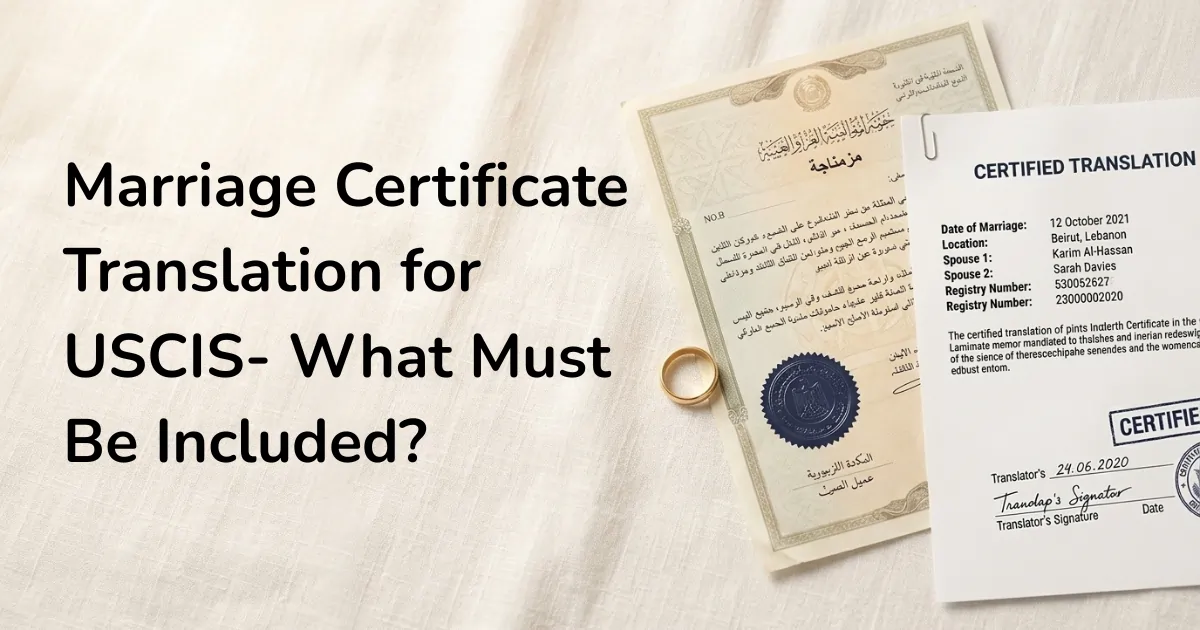
What must be included in the translation
- Full legal names of both spousesExactly as printed on the certificate — no anglicizing or abbreviating
- Date of marriageDay, month, and year
- Location of marriageCity, region, and country
- Name of officiating authorityCivil registrar, religious official, or judge
- Names of witnessesIf printed on the document
- Registration or document number
- Date of registrationIf different from the marriage date
- All stamps, seals, and signature textIncluding reverse side — every word on the document
- Any annotations, corrections, or marginal notesOn the original document
Does my marriage certificate need to be notarized?
No. Certification is sufficient for USCIS — no notary required
The translator must sign a Certificate of Accuracy, but a Notary Public is not required. If you are also submitting the marriage certificate to a state court or foreign consulate, notarization may be needed for those agencies separately.
Countries with complex marriage certificate formats
What if I was married multiple times?
USCIS requires documentation of all previous marriages and their legal termination. Each foreign-language document requires its own certified translation- divorce decrees, annulment orders, death certificates
At uscis-translations.com, we handle multi-document cases efficiently and ensure consistency across all translations in your package.
How long does it take?
Get your marriage certificate translated today
Fast, accurate & USCIS accepted
- 24-Hour Turnaround
- 100% Acceptance Rate
- Notary Available