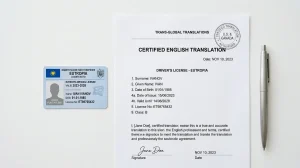

Why Romanian Document Translation Demands Precision
Romania’s increasing rate of U.S. immigration — driven by family reunification petitions, employment-based visas, and diversity visa programs — means thousands of Romanian-language documents are submitted to USCIS every year. Birth certificates, marriage records, court documents, academic transcripts: each one must meet the same non-negotiable standard before a USCIS officer will review your application.
Romanian is a Romance language with a formal legal register, diacritical characters, and civil record formats that differ significantly from U.S. documentation standards. A translator unfamiliar with Romanian legal language — or one who overlooks critical formatting requirements — can introduce errors that delay your case by months.
This guide covers exactly what USCIS requires from Romanian-to-English translations, what mistakes to avoid, and how to ensure your application moves forward without interruption.
USCIS Core Translation Requirements for Romanian Documents
1. Complete Translation — Every Element, Without Exception
USCIS requires that the entire document be translated. No section, stamp, seal, signature, annotation, or handwritten note may be omitted. This applies equally to:
- Printed text and typed fields
- Official stamps and their content
- Registrar signatures and titles
- Marginal notes or corrections on the original
- Watermarks or background text that carry informational content
Partial translations are not acceptable. If any portion of the original Romanian document is illegible or damaged, this must be explicitly noted within the body of the English translation.
2. Signed Certificate of Translation Accuracy
Every Romanian document submitted to USCIS must be accompanied by a signed Certificate of Translation Accuracy. This is a mandatory compliance requirement — not a formality.
The certification must include:
- A statement that the translator is competent in both Romanian and English
- A statement affirming the translation is accurate and complete
- The translator’s full name, address, signature, and date of certification
A standard certification statement reads: “I, [Translator’s Name], certify that I am fluent in English and Romanian and that the attached document is an accurate and complete translation of the original.”
Important: USCIS does not require notarization for most standard applications. The translator’s signed certification is sufficient. Some state agencies or specific visa categories may have additional requirements — verify before submitting.
3. Format Consistent With the Original
The translated document must closely replicate the layout and structure of the original Romanian document. USCIS officers routinely cross-reference translations against originals during review. A translation that reorganizes fields, omits headers, or departs from the original’s visual structure creates friction in that review process — and friction creates risk.
Maintain the same:
- Document layout and field positioning
- Headings, subheadings, and section labels
- Table or column structures where present
- Official titles and institutional identifiers
4. Legibility and Professional Presentation
The translated document must be clearly legible. Use a professional, readable font and maintain clean formatting throughout. Handwritten corrections or alterations on the translated document are not acceptable and may result in the submission being rejected on presentation grounds alone.
5. Translator Competency
USCIS does not require translators to hold a specific professional license. However, the translator must be genuinely competent in both Romanian and English — and must not be the applicant. Working with a professional translation service experienced in USCIS immigration document submissions is strongly recommended. The compliance requirements are precise, and errors carry real consequences for your case timeline.
Special Considerations for Romanian-to-English Translation
Romanian Diacritical Characters
Romanian uses five diacritical characters — ă, â, î, ș, and ț — that are critical to accurate spelling of names, places, and official terms. A translator who omits or substitutes these characters introduces inconsistencies that can create mismatches between your translated documents and other records in your application package. Name spelling must be exactly consistent across all submitted materials.
Romanian Civil Record Format
Romanian civil documents — particularly birth certificates and marriage certificates issued by the Romanian Civil Registry (Starea Civilă) — follow a standardized government format with specific fields, official language, and institutional references. A translator experienced with Romanian civil records will recognize these formats and render them accurately. A generalist translator may not.
Legal and Notarial Terminology
Many Romanian documents submitted to USCIS — particularly court records, divorce decrees, and affidavits — contain formal legal and notarial language. Romanian notarial terminology and judicial language have specific English equivalents that must be rendered precisely. Approximate translations of legal terms can alter the meaning of a document in ways that matter to a USCIS reviewer.
Documents Commonly Requiring Romanian-to-English Translation for USCIS
If any of the following documents are in Romanian, certified English translations are required for your USCIS application:
- Birth certificates (certificate de naștere)
- Marriage certificates (certificate de căsătorie)
- Divorce decrees (sentință de divorț)
- Death certificates (certificate de deces)
- Adoption records
- Academic diplomas and transcripts
- Police clearance certificates (cazier judiciar)
- Court records and legal judgments
- Medical records (for applicable visa categories)
- National identity documents (carte de identitate)
- Affidavits and notarized statements
Common Mistakes That Delay Romanian USCIS Applications
| Mistake | Consequence |
|---|---|
| Missing Certificate of Accuracy | Non-compliant submission; likely RFE |
| Omitting stamps, seals, or handwritten annotations | Application flagged as incomplete |
| Inconsistent diacritic rendering in names | Name mismatch across application documents |
| Using machine translation (Google Translate, etc.) | Does not meet USCIS certification requirements |
| Applicant translating their own documents | Not permitted under USCIS guidelines |
| Handwritten corrections on the translation | Legibility and presentation non-compliance |
| Reorganizing document layout | Hinders USCIS cross-referencing; raises flags |
Step-by-Step: How to Get Your Romanian Documents Translated for USCIS
Step 1 — Obtain a clear, high-quality copy of the original document Provide your translator with the clearest possible scan or photocopy. Quality input means quality output — poor image resolution leads to missed details and potential inaccuracies.
Step 2 — Select a professional translation service with USCIS experience Choose a service that specializes in Romanian-to-English immigration document translation. Confirm they are familiar with Romanian civil record formats and USCIS compliance requirements.
Step 3 — Review the completed translation carefully Compare the English translation against the original document field by field. Verify that names — including diacritical characters — are rendered consistently across all documents in your application package.
Step 4 — Confirm the Certificate of Accuracy is properly formatted Ensure the certification statement includes all required elements: translator name, address, signature, date, and the affirmation of competency and accuracy.
Step 5 — Submit originals and translations together USCIS requires both the original Romanian document and the certified English translation to be submitted together as part of your application package.
Frequently Asked Questions
Does USCIS require a notarized translation of Romanian documents? For most USCIS applications, notarization is not required. A signed Certificate of Translation Accuracy is sufficient. Verify requirements for your specific application type and any state agencies involved.
Can I translate my own Romanian documents for USCIS? No. USCIS does not permit applicants to translate their own documents. The translator must be a separate, competent individual who certifies the translation independently.
Do Romanian diacritical marks matter in USCIS translations? Yes. Diacritical characters affect the correct spelling of names and official terms. Inconsistent rendering can create document mismatches that trigger identity verification concerns during review.
What if my Romanian document is older and uses archaic language or formatting? Older Romanian civil documents — particularly those from the communist era or earlier — may use different terminology, formatting, and institutional references. A translator experienced with historical Romanian documentation is essential in these cases.
Can I use Google Translate for Romanian immigration documents? No. Machine translation tools cannot provide the signed certification required by USCIS and are not held to the accuracy standard required for legal document submissions.
Conclusion: Compliance Is What Moves Your Application Forward
Romanian documents submitted to USCIS must meet a precise standard — complete, accurately formatted, and accompanied by a signed certification. The specific characteristics of Romanian — its diacritical system, civil record formats, and formal legal register — mean that translator expertise is as important as language proficiency.
Professional translation services that specialize in Romanian-to-English USCIS submissions understand what federal reviewers expect. They deliver compliant, accurate translations that protect your application from preventable delays.
[Get a Free Quote for Certified Romanian-to-English Translation →]
USCIS-Translations.com provides certified English translations of Romanian immigration documents. Every translation includes a compliant Certificate of Accuracy and meets current USCIS standards. Contact us at support@uscis-translations.com or visit this page to get started today.