When court records must be translated for USCIS
Foreign court records — including criminal judgments, civil court orders, custody rulings, and restraining orders — frequently arise in immigration applications. USCIS requires certified English translations of all court documents in a foreign language. Inaccurate or incomplete court record translations can have serious consequences for your case, including grounds of inadmissibility findings or case denial.
Types of foreign court records that require translation
Court documents requiring certified English translation
- Criminal Conviction Records — Judgment documents stating charges, findings, and sentences
- Acquittal or Dismissal Orders — Court orders showing charges were dropped or the applicant was found not guilty
- Arrest Records Without Conviction — USCIS may require these even if no conviction occurred
- Civil Court Orders — Including restraining orders, injunctions, or civil judgments
- Child Custody and Guardianship Orders — For family-based immigration involving children
- Expungement or Pardon Records — Showing a prior conviction was legally cleared
- Probation and Parole Records — If referenced in immigration forms
Why accuracy in court record translation is critical
High-stakes translation — these errors have consequences
- USCIS cross-references translated court records with international law enforcement databases
- Any discrepancy between the original and the translation — even in dates or charge names — triggers an immediate RFE
- Mistranslated charge descriptions can incorrectly trigger bars to admissibility
- Expungement records must be translated precisely — an incomplete translation may make the expungement appear invalid
- Criminal records with foreign legal terminology require translators with legal expertise, not just language fluency
What every court record translation must include
Required translation elements
- Court name, city, and country of jurisdiction
- Case number or docket reference
- Full legal name of the defendant or party exactly as written
- All charges listed — using their closest English legal equivalent with the original term noted
- Date of hearing, judgment, and sentencing
- Sentence imposed — including duration, fines, probation terms, or acquittal statement
- Judge’s name and signature text
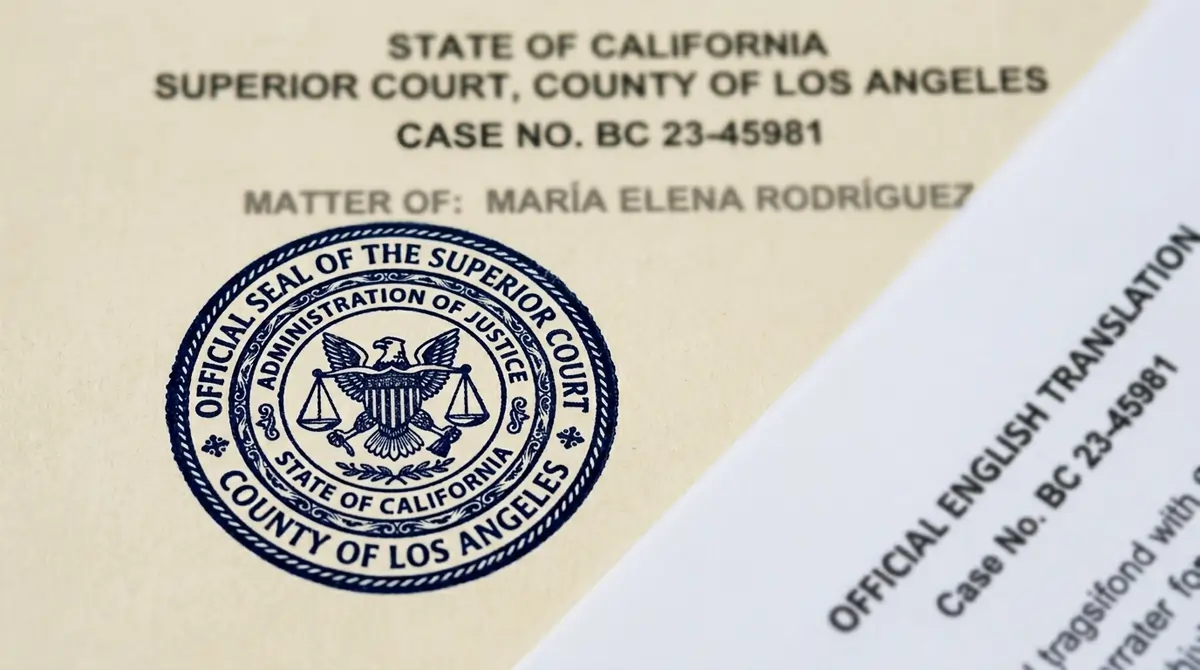
- All official court stamps, seals, and clerk’s annotations
Translating expungements and pardons
Expungements require the same precision as the original conviction
If you have received a legal expungement, pardon, or clemency in a foreign country, that document must be translated with the same precision as the original conviction record. USCIS evaluates pardons and expungements carefully — the translated document must make clear that the relief was granted by proper legal authority and is legally effective.
Work with legal translation specialists
Court record translation is not a task for a general translator. At uscis-translations.com, our legal translation team is trained in criminal and civil court terminology across multiple jurisdictions. Upload your court documents and receive a certified translation within 24–48 hours.
Need USCIS-Approved Certified Translation?
Fast, accurate & USCIS accepted
- 24-Hour Turnaround
- 100% Acceptance Rate
- Notary Available