Three terms that confuse nearly every applicant
If you have spent any time researching immigration document requirements, you have almost certainly encountered three terms that cause enormous confusion: certified translation, notarization, and apostille. These three processes are completely different, serve different purposes, and are required by different agencies in different situations.
Getting them mixed up can cost you significant time and money. This guide clears everything up once and for all.
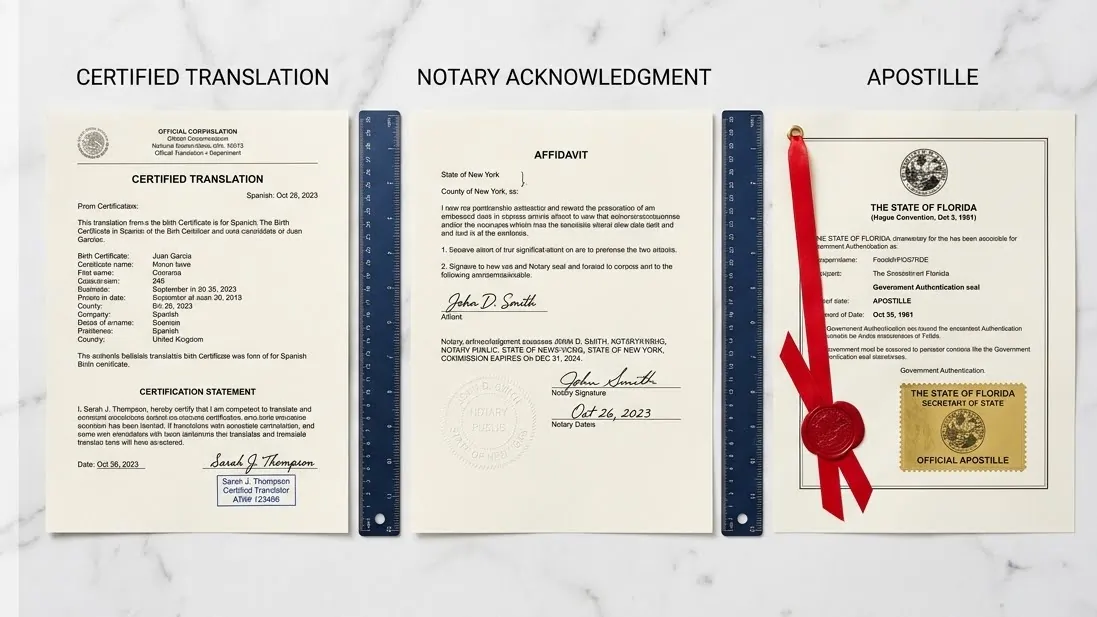
A translated document with a signed declaration from the translator confirming accuracy and completeness.
Issued by: the translator
Required by USCISA Notary Public witnesses and verifies the signature on a document. Does NOT verify translation accuracy.
Issued by: a Notary Public
Not required by USCISAn international government certification authenticating a document for use in another country.
Issued by: Secretary of State
Rarely needed for USCISwhat is a Certified translation?
A certified translation is a translated document accompanied by a signed declaration from the translator, confirming that the translation is complete, accurate, and performed by a competent bilingual professional. This is what USCIS requires for all foreign-language documents submitted with immigration applications.
Notarization — what it is
Notarization is performed by a Notary Public — a government-appointed official who verifies the identity of the person signing a document and witnesses the signature. When applied to translation, the notary witnesses the translator signing the Certificate of Accuracy and confirms the identity of the signer.
what is an Apostille
An apostille is an international certification attached to an official document — such as a birth certificate or court order — that authenticates it for use in another country. It is issued by a designated government authority, typically the Secretary of State at the state level in the USA.
Apostilles are used under the Hague Convention of 1961 and are required when submitting official documents from one member country to another. They are almost never required by USCIS for your immigration application itself.
Quick comparisonType Who issues it Required by USCIS Common use Certified Translation The translator Yes — always All USCIS immigration filings Notarized Translation Notary Public No State courts, universities, some consulates Apostille Secretary of State No International document authentication Certified + Notarized Translator + Notary Sometimes Dual-agency filings (USCIS + state board) Apostille + Certified Gov. authority + Translator No Using US documents abroad
| Type | Who issues it | Required by USCIS | Common use |
|---|---|---|---|
| Certified Translation | The translator | Yes — always | All USCIS immigration filings |
| Notarized Translation | Notary Public | No | State courts, universities, some consulates |
| Apostille | Secretary of State | No | International document authentication |
| Certified + Notarized | Translator + Notary | Sometimes | Dual-agency filings (USCIS + state board) |
| Apostille + Certified | Gov. authority + Translator | No | Using US documents abroad |
Real-world scenarios1Your situationApplying for a green card and submitting a foreign birth certificate to USCIS
What you needCertified translation only — no notarization, no apostille
2Your situationApplying for a green card AND enrolling in a US university — both require your foreign diploma
What you needCertified translation for USCIS + a notarized version for the university (two separate documents from one order)
3Your situationA foreign court requires your US divorce decree
What you needAn apostille on your US document + a certified translation into the foreign language
Applying for a green card and submitting a foreign birth certificate to USCIS
Certified translation only — no notarization, no apostille
Applying for a green card AND enrolling in a US university — both require your foreign diploma
Certified translation for USCIS + a notarized version for the university (two separate documents from one order)
A foreign court requires your US divorce decree
An apostille on your US document + a certified translation into the foreign language
Still unsure? We will tell you exactly what you need
Every case is different. At uscis-translations.com, our team reviews your specific situation and advises you on exactly which type of document authentication you need — certified, notarized, or both — so you never pay for more than necessary and never miss a requirement.
Need USCIS-Approved Certified Translation?
Fast, accurate & USCIS accepted
- 24-Hour Turnaround
- 100% Acceptance Rate
- Notary Available